The solution is designed primarily for two-wheeler EV riders, as battery swapping is currently more common and practical in this segment.
Users access the service mainly through a mobile-first interface, since riders typically check battery status and find stations while on the move.
Swap stations provide real-time battery availability and verified battery health data, enabling users to make informed decisions.
Users may experience different urgency levels (normal, low battery, emergency), so the experience adapts based on their battery status.
Emergency assistance and battery delivery services are assumed to be available in supported service areas.
In-station service via QR scanning is not covered under this assignment
EV riders frequently experience range anxiety because finding a reliable battery swap station, confirming availability, and trusting battery health is often unclear and time-consuming. There is a need for a simple, real-time battery swap experience that helps users quickly locate, reserve, and swap batteries with confidence, especially during time-sensitive situations.
Since I had not personally experienced how EV battery swapping works in real life, I began by conducting a quick primary user study to understand the real process.
(Photo taken purely for user research, the jacket is incidental, my career ambitions are still clearly pointed toward Blinkit :)
Meet Ramesh. As a daily rider, he doesn't just use EVs, he relies on them. He shared his passion for the tech, but also his experience with finding charged batteries in a pinch

I broke the problem into three guiding questions:
What does the user need to know
immediately when their battery is low?
What decisions does the user need to make and how can we simplify them?
How do we build trust in an invisible asset like a battery?
Before designing the flows, I mapped the battery swap experience based on user emotional states, because EV riders make decisions differently depending on their battery level and urgency.
Instead of designing a single generic journey, I structured the experience across three real-world riding scenarios:
During regular rides, users usually check their battery casually to understand whether they need a swap later. In this situation, the experience focuses on clarity and convenience — showing battery percentage, estimated range, nearby stations, and easy reservation options. Since there is no urgency, the interface stays calm and informative, allowing users to plan their swap smoothly without pressure.

Clear battery visibility
Easy discovery of nearby
stations
Smooth reservation and
navigation flow
Transparency in battery
health and availability
HOMESCREEN :
This screen is designed to act as a decision dashboard, where users can immediately understand their battery situation and take the next logical action, find a station, navigate, or start a swap within seconds of opening the app.

STATION LISTING PAGE
Users choosing a swap station are typically in transit and time-sensitive, so the interface prioritizes decision-ready information (distance, availability, wait time) directly on the listing cards, enabling users to select a station within seconds without needing to open multiple screens.
Entry Points to This Screen: “Find Station” CTA, “View All” and Bottom Navigation → Stations tab

STATION DETAIL PAGE
This screen helps users confidently finalize their station decision by presenting availability, effort required to reach, and battery trust indicators in a single view before reservation.

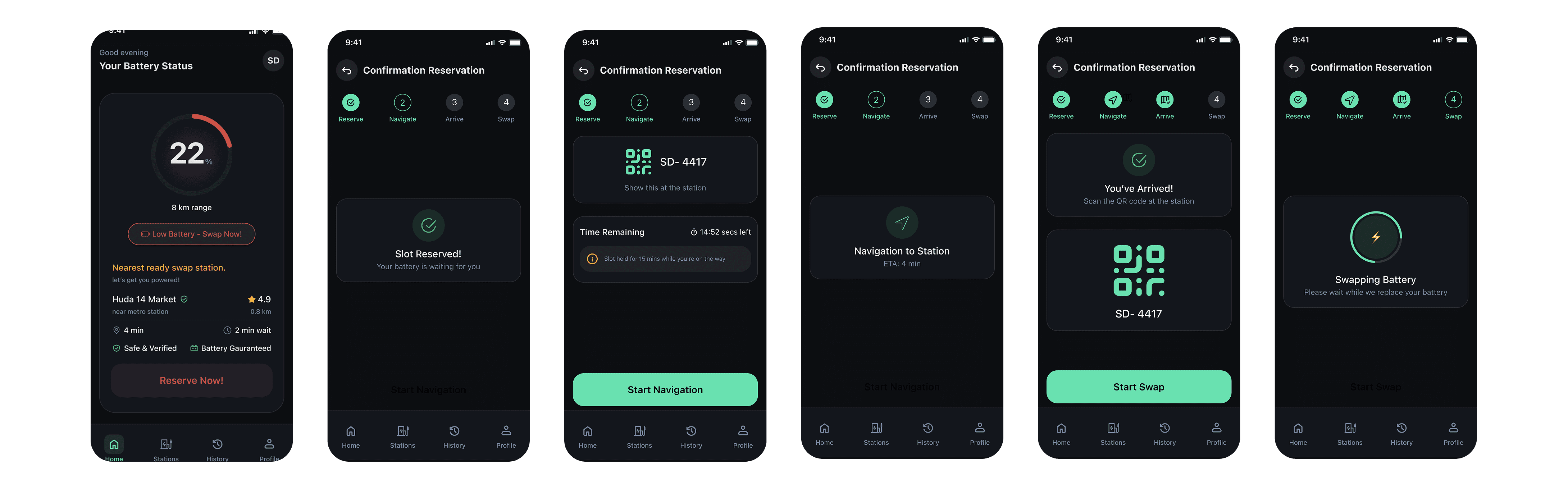
Reservation → Navigation → Swap Flow
This flow guides the user step-by-step from battery reservation to successful battery swap, ensuring clarity, predictability, and reduced stress throughout the physical swapping journey.

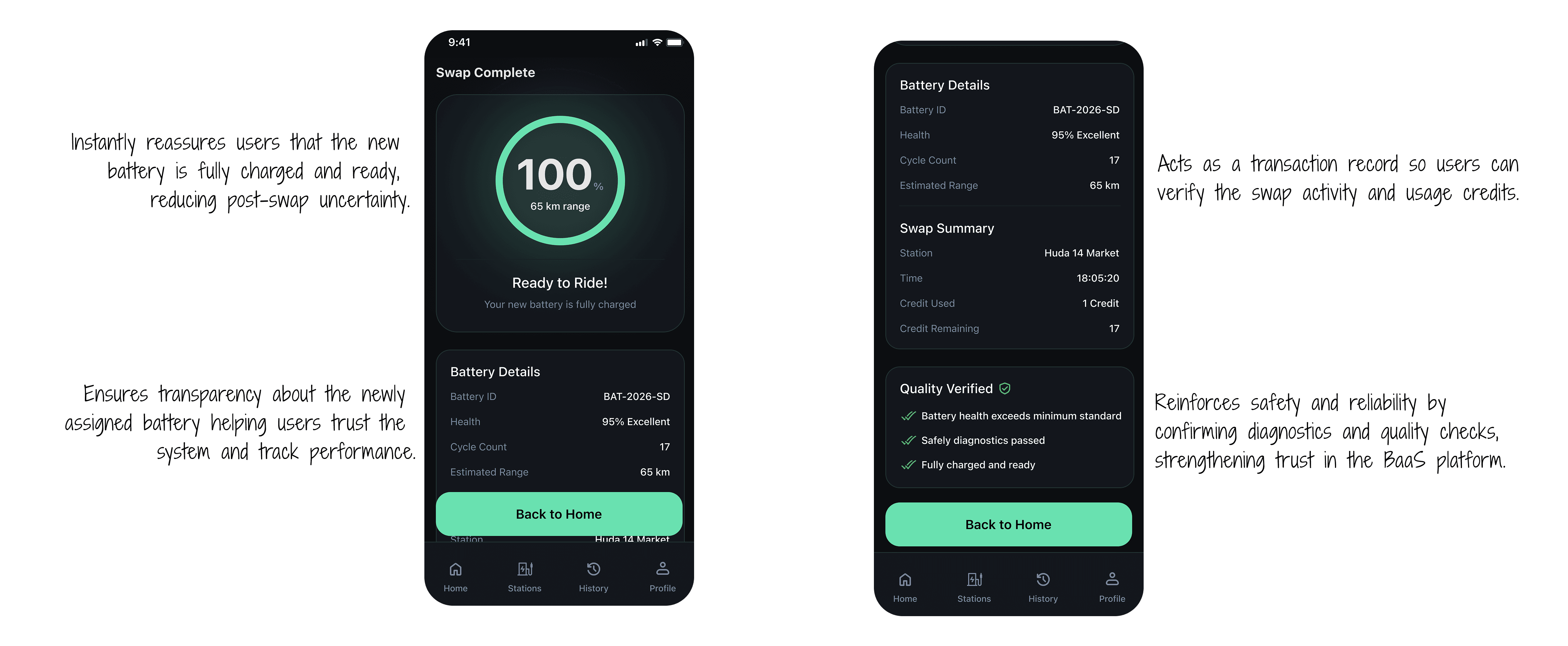
SWAP COMPLETE SCREEN
This screen confirms that the battery swap has been successfully completed and reassures the user that the new battery is fully charged, verified, and ready for use.
As battery levels drop, users begin to feel concerned and want quick reassurance that they can still reach a nearby station. The interface automatically highlights the nearest reachable swap station, surfaces quick reserve actions, and reduces unnecessary information so users can make faster decisions while continuing their journey.

Highlighting the nearest
available station automatically
Showing
“Reachable stations first”
Navigate Now
Reduced on-screen distractions
to speed decision making
HOMESCREEN :
This screen is designed for high-urgency situations, where the user’s battery is critically low and quick action is required. The interface shifts from exploration to guided decision-making, helping users immediately reserve the nearest reachable swap station.

UX DECISION:
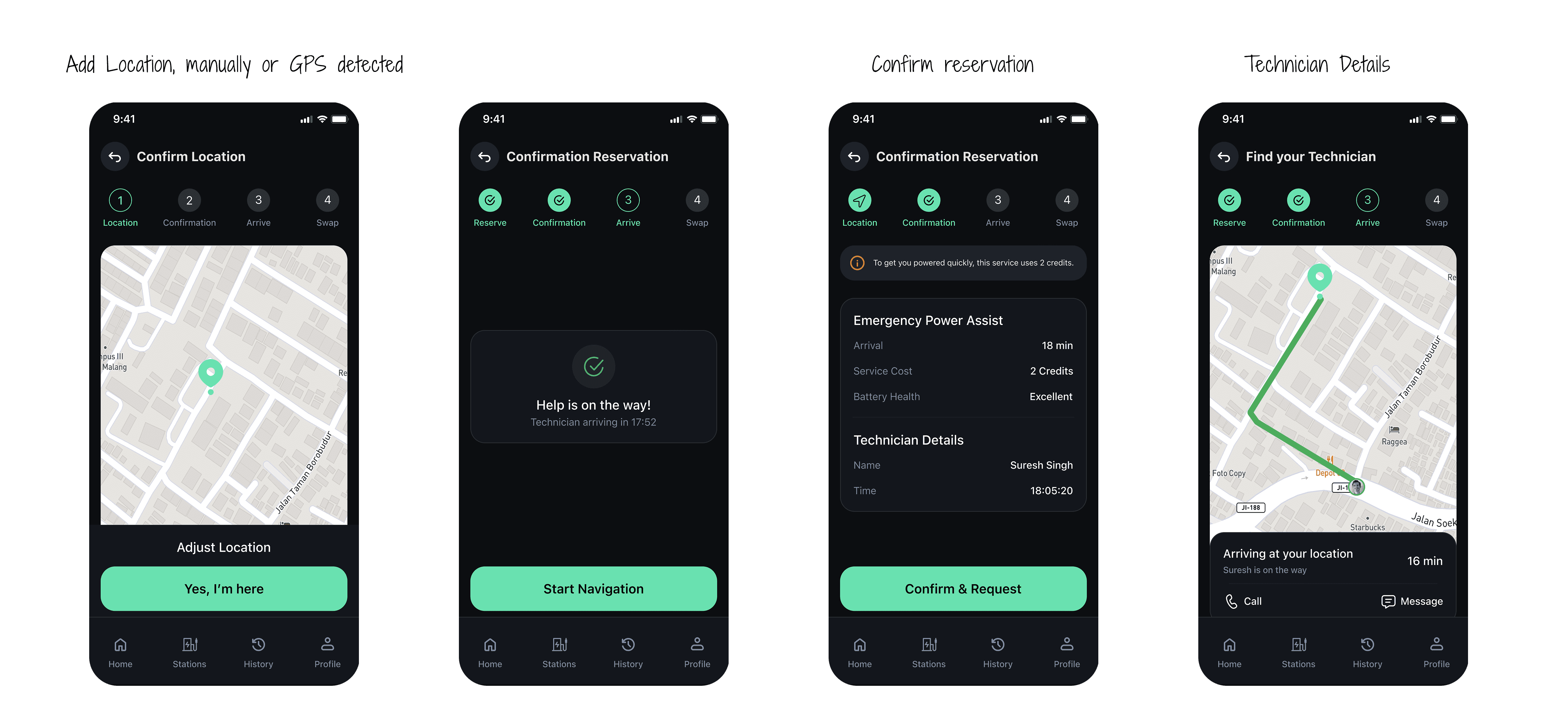
When the remaining range is lower than the distance to the nearest station, the situation becomes critical. In this case, the system shifts from station discovery to rescue assistance, offering emergency battery delivery or support options so users are not stranded.
The experience focuses on immediate help, automatic location detection, and clear arrival time communication, ensuring users feel supported even in the most stressful moments.

Request Emergency
Power
Confirm Location
Get Technician Detail
Swap
HOMESCREEN :
This screen is designed for high-urgency situations, where the user’s battery is critically low and quick action is required. The interface shifts from exploration to guided decision-making, helping users immediately reserve the nearest reachable swap station.

Flow:
This screen is designed for high-urgency situations, where the user’s battery is critically low and quick action is required. The interface shifts from exploration to guided decision-making, helping users immediately reserve the nearest reachable swap station.
UX DECISION:
Critical Warning Message (“You may not reach the station safely”)
Clearly communicates the risk so users immediately understand the seriousness of the situation.
Emergency-Focused Primary CTA (“Request Emergency Power”)
Replaces the standard reservation flow with a rescue action, guiding users toward the most relevant next step instead of forcing them to search for alternatives.
Automatic Location Detection & Arrival Time Estimate
Reduces effort during panic situations by auto-filling the user’s location and showing technician ETA, helping users feel reassured that help is on the way.
Support & Safety Indicators (Technician Support, Health Verified)
Builds trust in the emergency service, ensuring users feel safe allowing technician intervention.
Nearest Stations Still Visible Below
Keeps alternative options accessible in case users still want to attempt reaching a station.
Business Impact
Emergency battery delivery introduces a premium service layer that users are willing to pay extra for during urgent situations.
This creates an additional revenue stream for the platform while simultaneously improving user trust, reliability perception, and long-term customer retention — benefiting both the business and the rider experience.
ACCOUNT SCREEN
Provides a centralized space for users to manage their personal details, subscription access, and account-level settings.

HISTORY SCREEN
Allows users to track past battery swaps, performance improvements, and savings over time.

SUBSCRIPTION PLAN SCREEN
Helps users understand their current plan usage, billing transparency, and available upgrade/downgrade options.

Warehouse Partnership Network
Battery companies can partner with existing warehouses, service centers, or logistics hubs to store batteries, enabling faster emergency delivery without building new infrastructure everywhere.
Peer-to-Peer Emergency Charging
nearby compatible EV riders can share a small amount of battery charge when a user enters a panic state (range lower than reachable stations). The system automatically detects nearby vehicles, sends assistance requests, and rewards helping riders with credits or incentives. This creates a community-powered backup energy network, reducing range anxiety especially in low-infrastructure areas.
Dynamic Battery Subscription Plans
AI-driven subscription recommendations based on monthly usage can automatically suggest cost-optimized plans, improving customer retention and increasing upgrade conversions.
Smart Predictive Swapping
Using ride patterns and battery usage data, the system can predict when users are likely to need a swap and proactively suggest stations along their usual routes, reducing last-minute stress.
Dark Stores as Battery Micro-Hubs
Blinkit’s existing warehouses can act as battery stocking and dispatch points, enabling quick emergency battery delivery or swap services within the same 10–20 minute delivery radius. This reduces setup costs and accelerates market expansion.
Ecosystem Advantage
Since many Blinkit delivery partners already use EV vehicles, integrating battery swapping services improves fleet efficiency, reduces downtime, and positions Blinkit not just as a delivery company but as a hyperlocal mobility infrastructure provider.
Dynamic Battery Subscription Plans
AI-driven subscription recommendations based on monthly usage can automatically suggest cost-optimized plans, improving customer retention and increasing upgrade conversions.
IMPACT
By combining its logistics strength with battery swapping infrastructure, Blinkit can evolve from a quick-commerce company into a hyperlocal energy and mobility platform, unlocking a completely new business vertical.